
Last updated September 20, 2026
Free on-site gate assessment - hinges, posts, and your LiftMaster or Nice gate operator checked before anything is quoted
The assessment is free and the quote is the invoice.

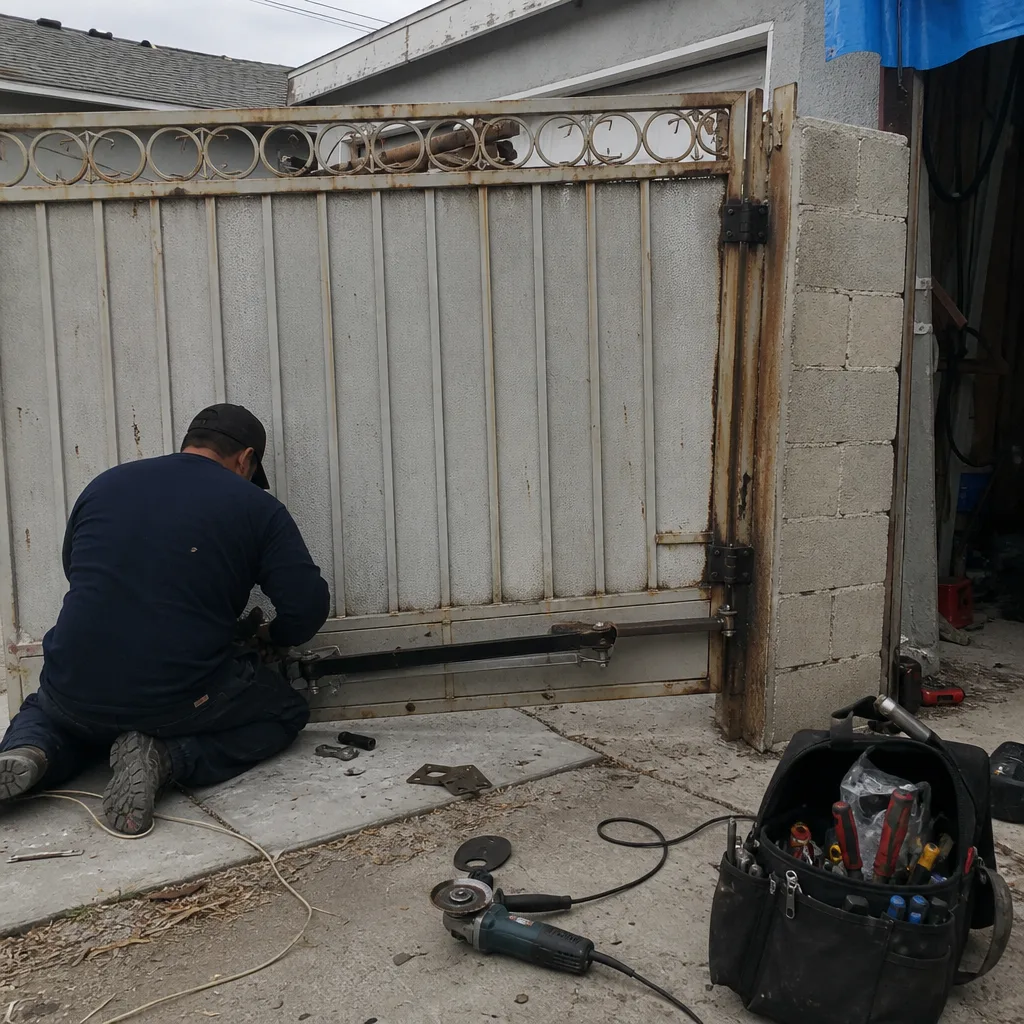 Before
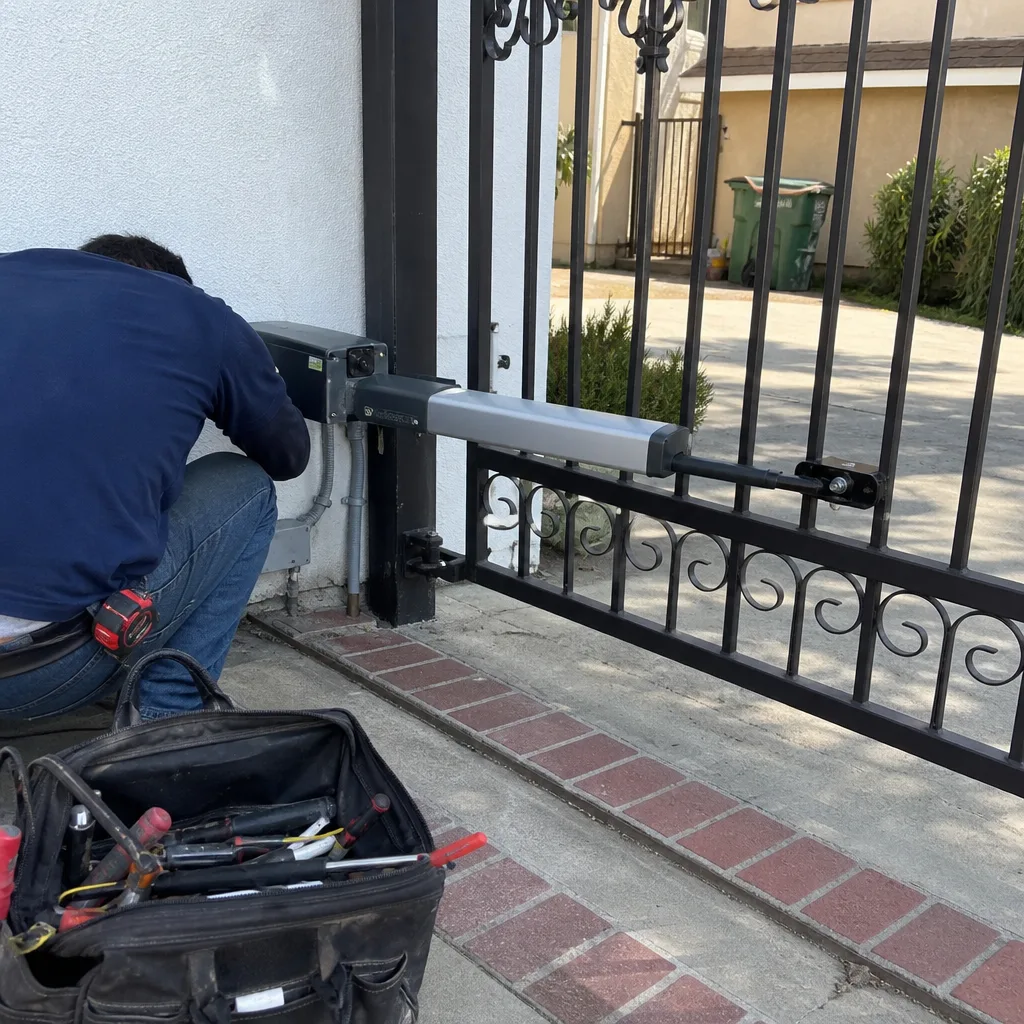 After
After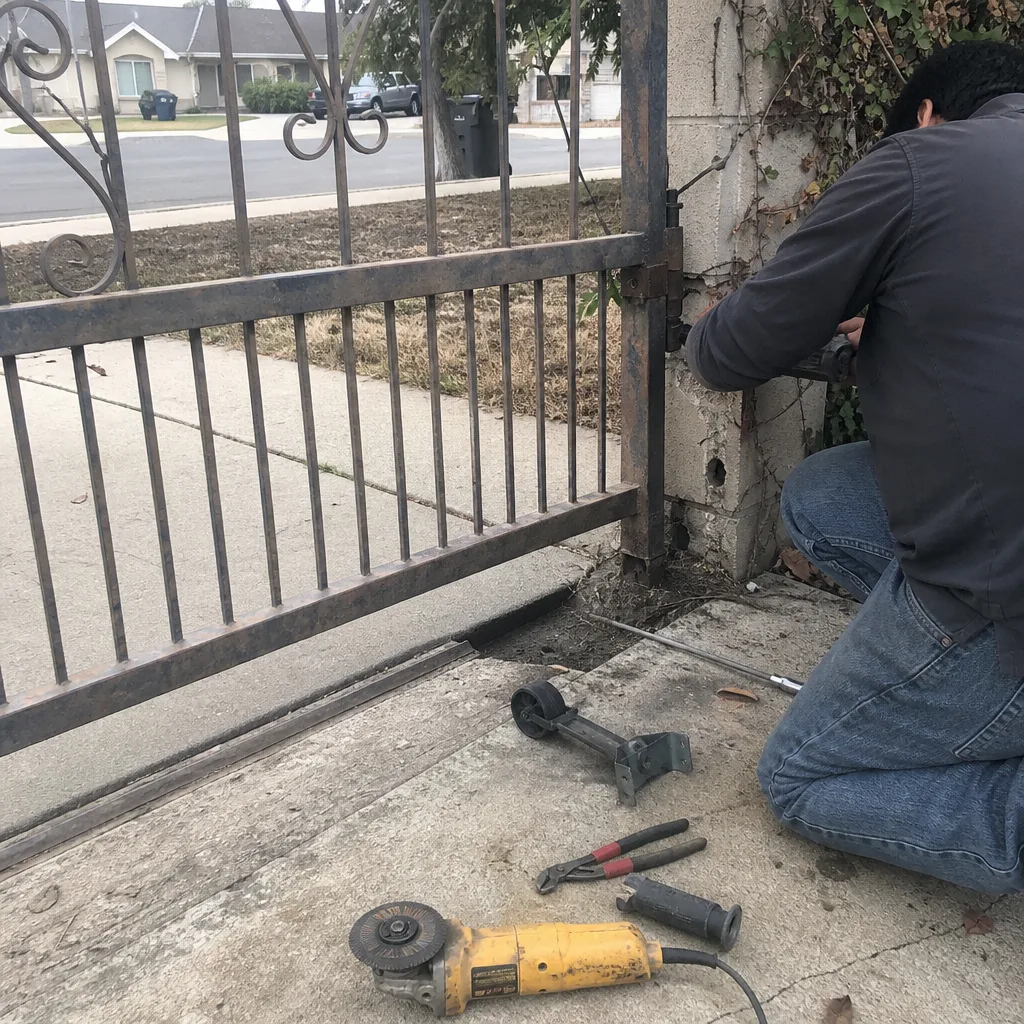 Before
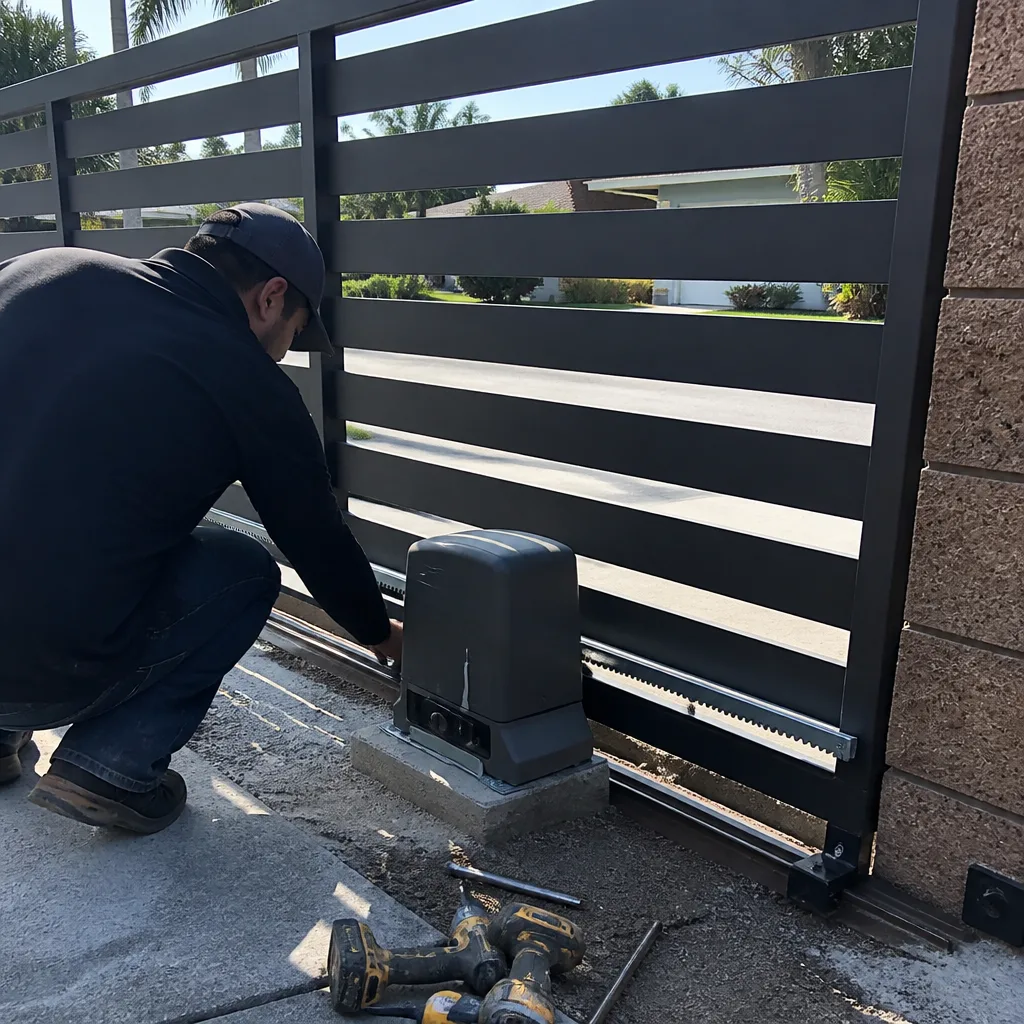 After
After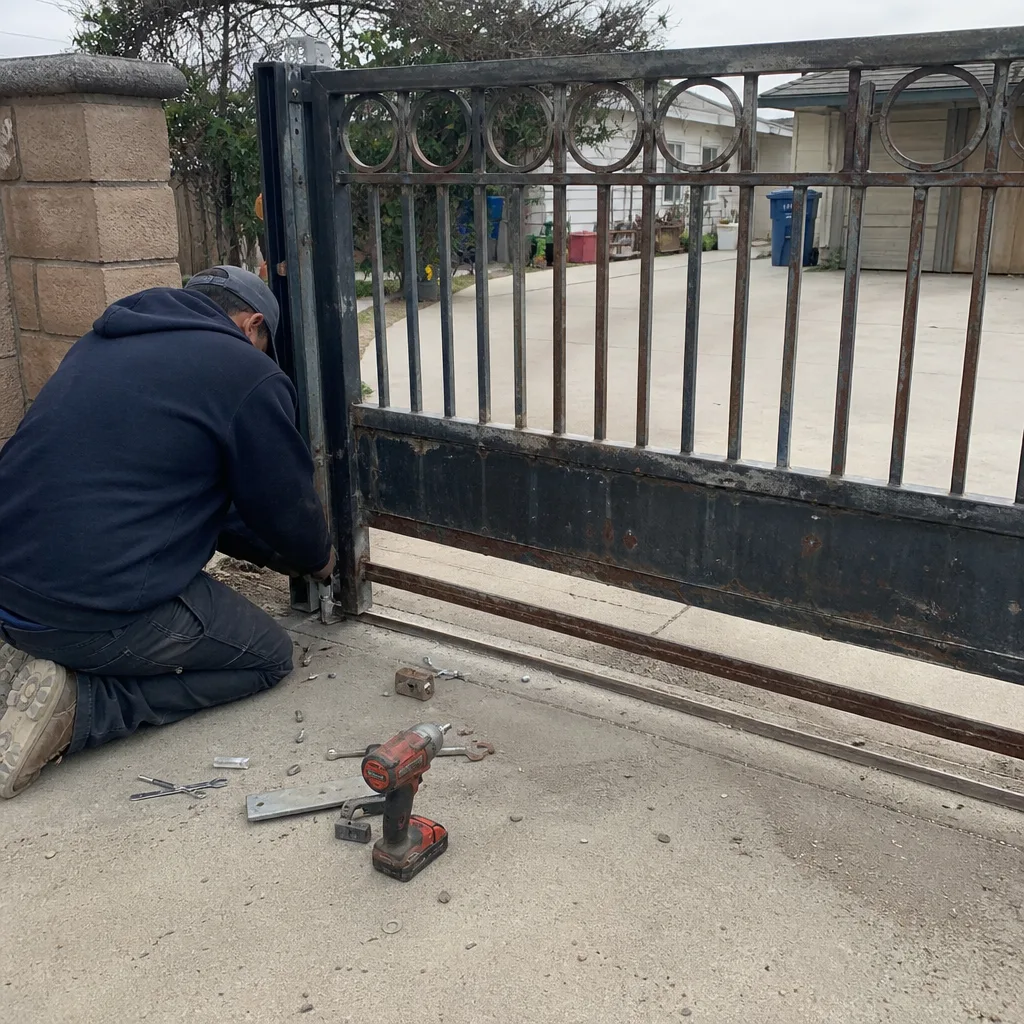 Before
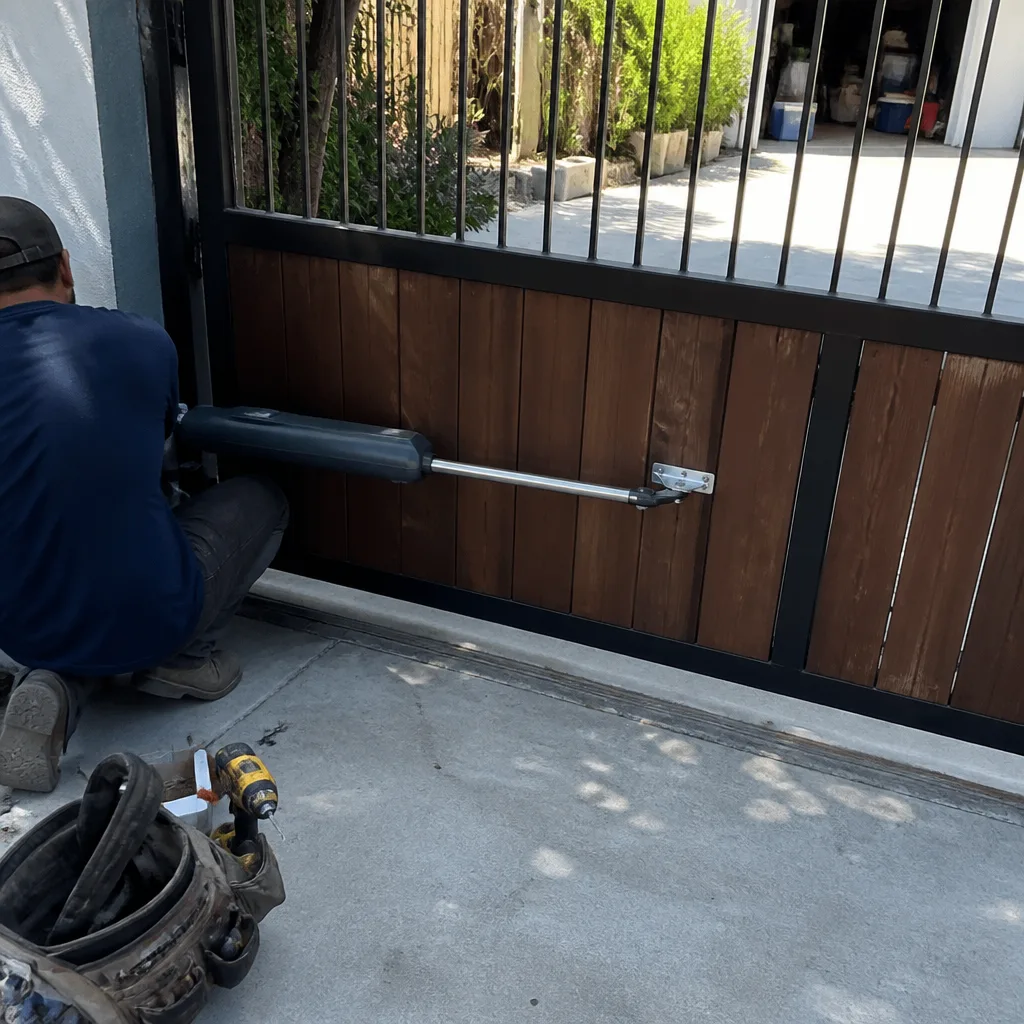 After
AfterGate Repair Warning Signs: A Santa Ana Homeowner’s Reference Guide
A gate that hesitates half a second longer than it used to isn’t a nuisance. It’s a motor drawing elevated current to overcome an alignment problem that will burn out the control board in four to six weeks. The hesitation is the warning sign. Most homeowners adjust to it, the way you adjust to a refrigerator that hums louder in summer, and then one morning the gate simply won’t open. This guide is written for Santa Ana homeowners who would rather catch the problem at the half-second phase than at the no-response phase. Each warning sign below is paired with a measurable threshold you can check yourself, so you’re comparing your gate against a defined baseline rather than a vague feeling that something is off.
Quick Answer
The most reliable early warning signs of gate failure in Santa Ana are a change in open/close cycle time of more than 2 seconds, a motor that runs hot enough to smell after normal use, visible lean in the gate post of more than 1.5 degrees from plumb, and intermittent opener response that gets blamed on remotes but is usually the control board or power supply. Any one of these justifies a diagnostic visit before the failure becomes total. In our experience across Santa Ana, most gate failures announce themselves two to six weeks in advance if you know which measurement to watch.
Table of Contents
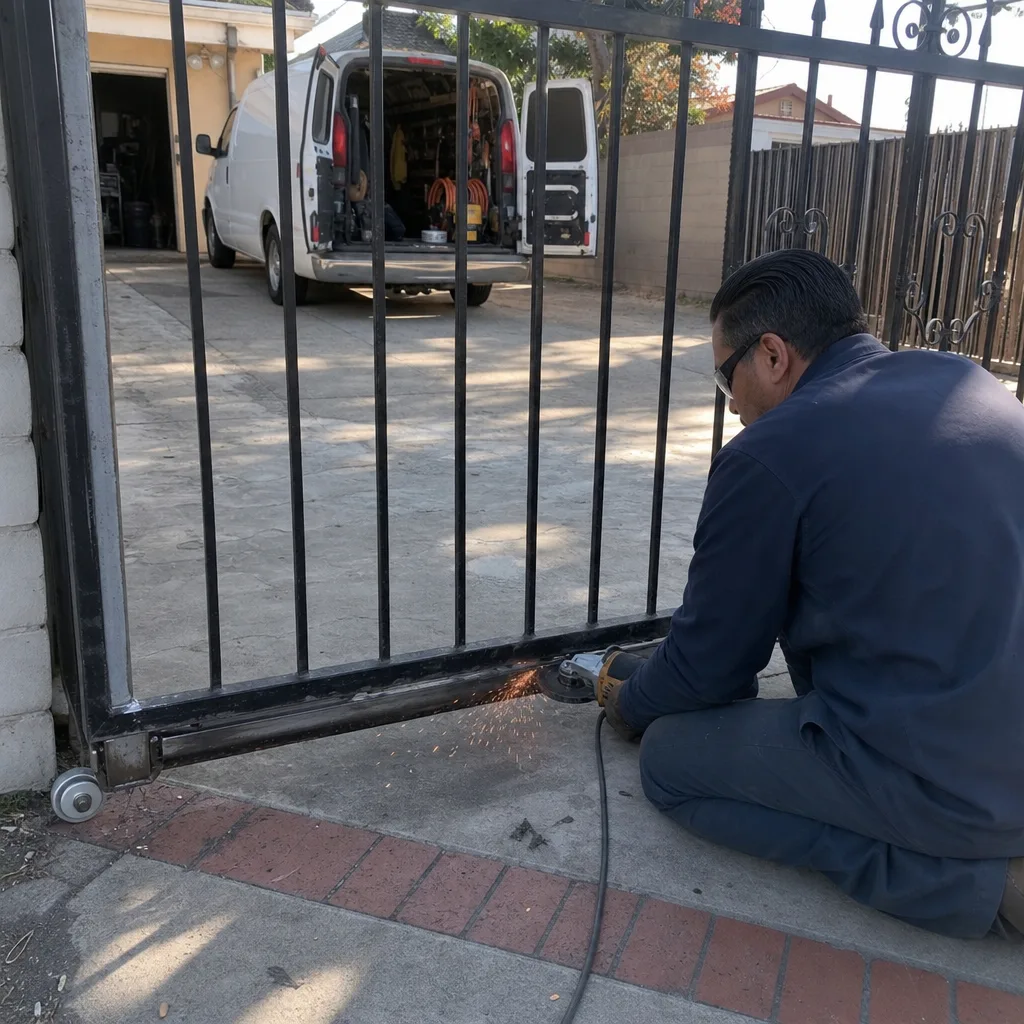
- The Cycle-Count Method: Timing Your Gate to Detect Motor Strain
- Visual Weld Inspection for Non-Engineers: Where Swing Gate Frames Crack First
- Intercom and Access Control Signs That Aren’t Your Phone’s Fault
- The Ground Heave Test for Santa Ana Clay Soil
- How to Document a Warning Sign So a Technician Can See the Progression
- What Changed Noise Actually Tells You About Your Gate Motor
- Photo-Eye and Safety Edge Warning Signs Most People Miss
- Common Mistakes to Avoid
- When to Call a Professional
- Frequently Asked Questions
- The Bottom Line
BeforeAfterThe Cycle-Count Method: Timing Your Gate to Detect Motor Strain
A healthy residential swing gate in Santa Ana takes between 12 and 18 seconds to complete a full open cycle, depending on gate weight, leaf length, and the motor model installed. A slide gate typically runs 15 to 22 seconds. The exact number matters less than the change from your gate’s own baseline. This is where the cycle-count method comes in.
The principle is simple: a motor under strain slows down. Not dramatically at first, which is why most people miss it. But it slows down measurably. Current draw increases before heat becomes detectable, and heat becomes detectable before the circuit board fails.
Here is the method we teach to homeowners who call us for gate repair in Santa Ana:
- Establish your baseline on a normal day. Use your phone’s stopwatch. Stand where you can clearly see the gate. Time three full open cycles from start click to full stop, and three close cycles. Average them. Write the numbers down. This is your gate’s normal operating signature.
- Retest once a month, or after any weather event. Santa Ana’s dry heat followed by the occasional heavy rain from winter storms is exactly the combination that accelerates hinge wear and post movement. If the average open time increases by more than 2 seconds, something is physically resisting the motor.
- Listen for what the motor does at the end of travel. If the motor runs for a full second or more after the gate physically stops moving, the limit switch is set past the mechanical stop. That single second of stall current is enough to overheat a control board over a few hundred cycles.
- Feel the motor housing after ten consecutive cycles. Not the opening, the housing. If it is uncomfortably hot to hold for more than two seconds, the motor is working beyond its duty rating. Residential gate motors are not built for continuous operation, but ten cycles should not cook one.
In Santa Ana, where summer surface temperatures regularly exceed 110 degrees on metal gate panels, the thermal margin is already thin. A motor running hot on a 75-degree evening is a motor that will shut down on a thermal overload the first time the temperature spikes. The warning sign was there in the timing data weeks earlier.
Visual Weld Inspection for Non-Engineers: Where Swing Gate Frames Crack First
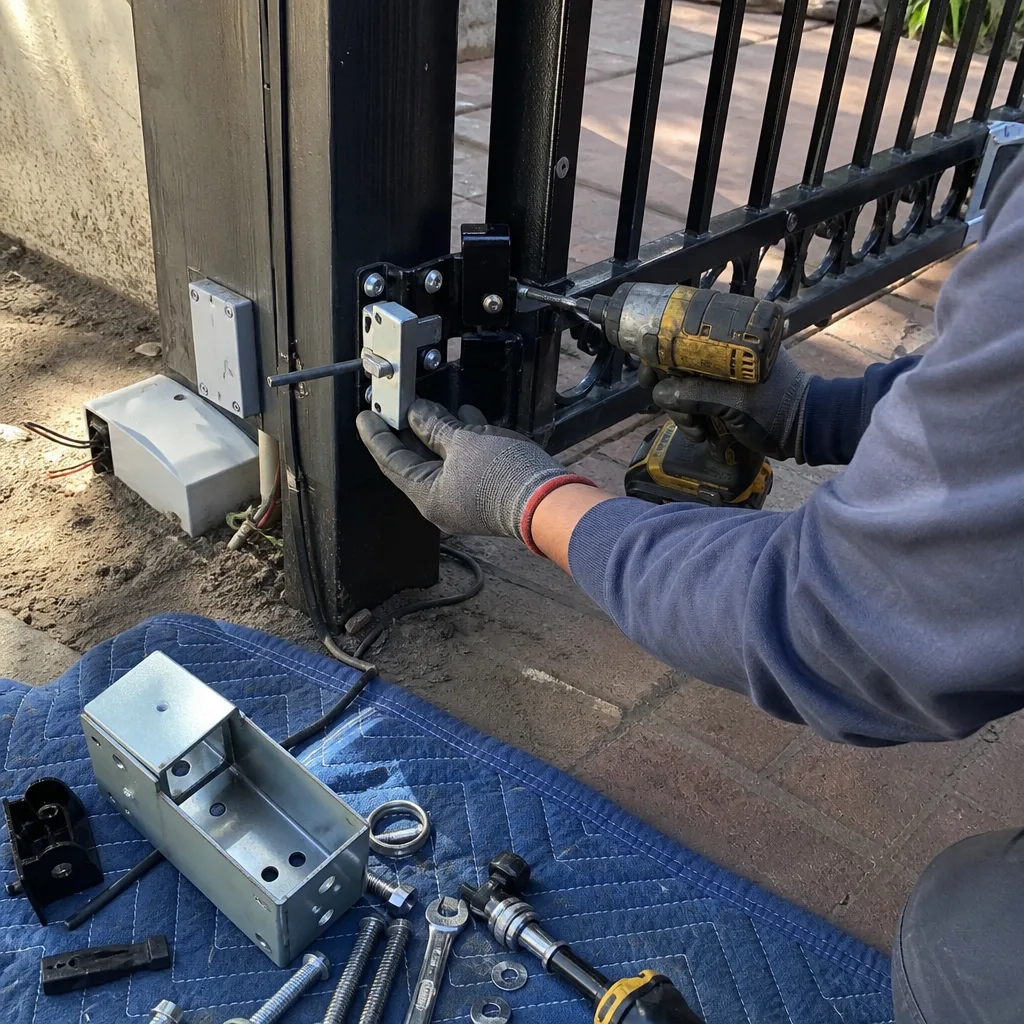
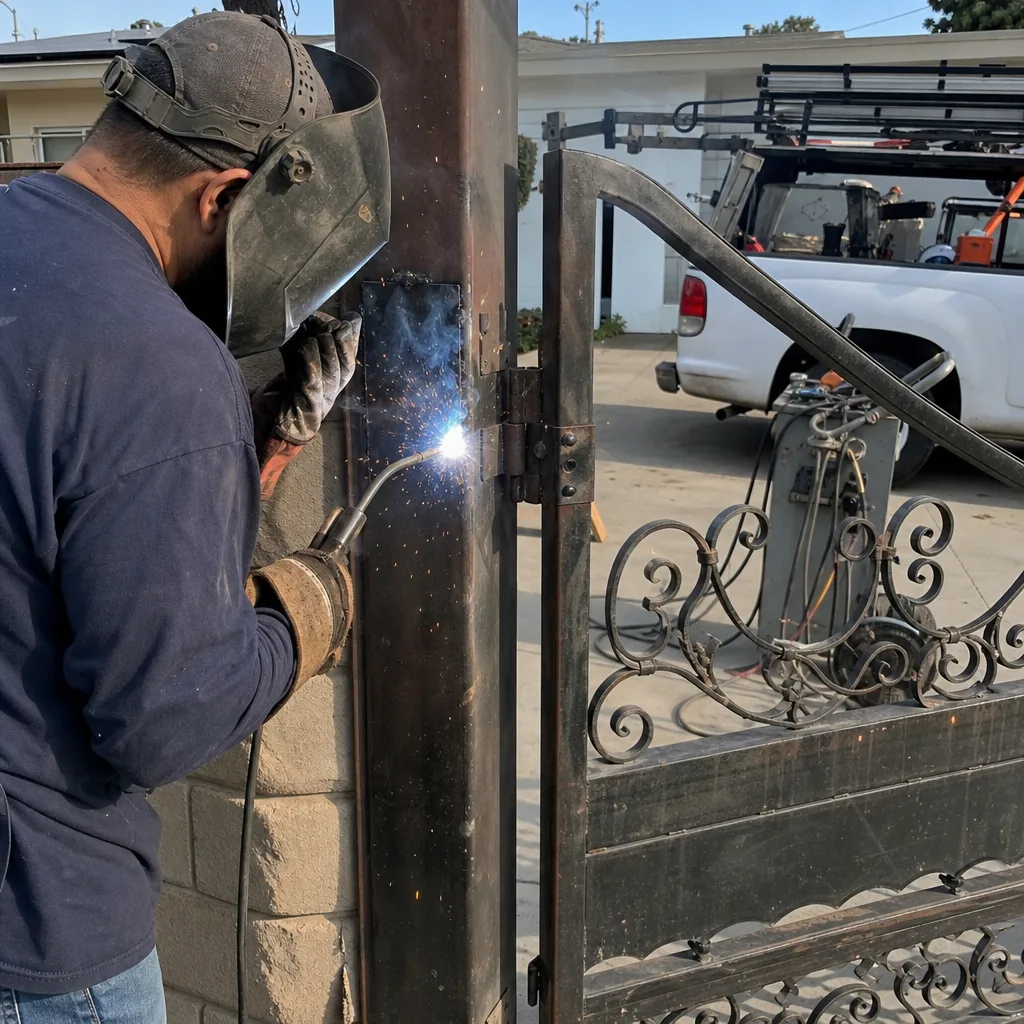
You don’t need to know how to weld to inspect a weld. You need to know where cracks appear, what they look like, and how to tell them apart from superficial surface rust. Swing gates fail at the welds for a predictable reason: repeated flexing at the joints concentrates stress where the frame member meets the hinge plate and where the diagonal brace terminates.
Three locations on a Santa Ana swing gate account for the large majority of frame failures we document:
- The top hinge plate weld, on the leaf side. This weld carries the full cantilevered weight of the gate every time it moves. Cracks here start as hairline lines running parallel to the weld bead, often with a faint rust-colored line spreading from the crack itself. Surface rust, by contrast, stays at the surface and wipes partially away with a cloth.
- The bottom corner of the latch stile, where the lower rail meets the vertical frame. This is where the gate’s own weight combines with the impact of every close cycle. Look for a crack that opens slightly when the gate is pushed by hand, then closes when released.
- The diagonal brace connection point. On gates with a Z-brace or diagonal member, the brace terminates mid-panel. If the gate racks, or twists slightly as it moves, that brace termination flexes and eventually cracks.
The test is physical, not just visual. Push the gate by hand at the latch end, applying moderate force perpendicular to the gate face. Watch the hinge weld. If you can see any opening of a hairline crack, even half a millimeter, the frame has already lost structural integrity at that point. Weld cracks do not self-heal. The gate gets heavier on the motor with every cycle, which is why a cracked frame and a burned out motor are often discovered at the same service call.
If you catch the crack while it is still a hairline, a mobile welding repair is a modest job. If you wait until the leaf visibly sags, you are usually looking at gate installation in Santa Ana rather than a repair.
Intercom and Access Control Signs That Aren’t Your Phone’s Fault
When an intercom at a Santa Ana driveway gate starts cutting out, the first instinct is to blame the app, the phone, the Wi-Fi, or the handset. Sometimes the instinct is right. More often, the real problem is electrical and it is hiding in plain sight.
Here are the symptoms that point to a failing power supply or a corroded ground, not a software issue:
- Static that increases when the gate motor activates. If the intercom is clear when the gate is idle and crackles only when the motor runs, the issue is almost certainly shared wiring or a weak ground. The motor’s current draw is interfering with the audio signal.
- Intermittent call button response on multiple different phones or handsets. When two different devices fail at the same panel, the panel is the problem. The power supply that feeds the access control board may be delivering 9 volts instead of 12, enough to keep the LED alive and nothing else.
- A keypad that works in the morning and fails in the afternoon heat. This is a classic Santa Ana pattern. Components expand in the heat, old solder joints separate, and the keypad stops registering inputs. The homeowners who call us often think the keypad is worn out. It is usually the board behind it.
- Corrosion at the ground connection. Any access control system that shares a ground with the gate motor needs that ground connection to be clean and tight. In Santa Ana’s coastal humidity, corroded ground lugs are routine. The symptom: the gate opens on the first button press, ignores the next three, then opens again.
We service access control systems from Linear, DoorKing, and Viking, among others, and the failure pattern is consistent: the electronics are rarely the first thing to die. The power feeding them is. If your intercom is behaving like a teenager, check the power supply before you replace the phone.
The Ground Heave Test for Santa Ana Clay Soil
Santa Ana sits on soil with a high clay content. Clay expands when wet and contracts when dry. Over years of drought-and-rain cycles, the ground around a gate post moves enough to shift the post itself. This is ground heave, and it is the most common cause of gate misalignment we see in Santa Ana that isn’t related to a car strike.
A gate post that is out of plumb by more than 1.5 degrees is a real problem. Here is how to measure it with a basic level:
- Place a 4-foot level vertically against the side face of the post. Use the face that is parallel to the gate’s swing path, since that’s the direction misalignment matters most.
- Read the bubble. If the bubble floats dead center, the post is plumb in that plane. If it touches the line, that’s 0.5 degrees, which is generally acceptable for a functioning gate.
- If the bubble is fully outside the center window, measure the gap. Hold the level flat against the post at the top and measure the gap between the level and the post at the bottom, or vice versa. A quarter-inch gap over 48 inches is 0.3 degrees. A half-inch gap is 0.6 degrees. A gap of 1.25 inches or more means you have passed the 1.5-degree mark.
- Repeat on the opposite face. Posts rarely move in only one direction. Check both planes.
Why 1.5 degrees? Because a typical residential swing gate has a latch gap of 1 to 2 inches, and a post lean of 1.5 degrees moves the latch end of an 8-foot gate by roughly 2.5 inches. The latch no longer reaches the receiver. The hinges bind. The motor works harder. One problem creates four.
In some parts of Santa Ana, particularly older neighborhoods with mature trees and unamended soil, we see post movement within five years of a new installation. If the lean is caught at under 1 degree, resetting the post is a contained job. If the lean passes 2 degrees, the gate usually needs to be removed, the footing cut out and re-poured, and the gate re-hung.
How to Document a Warning Sign So a Technician Can See the Progression
The single most valuable thing a homeowner can do before calling a gate company is document the abnormality. Not with a paragraph of description, but with a repeatable set of photos and measurements that a technician can interpret in seconds.
This matters because many gate problems are intermittent. The gate hesitates on Tuesday, works fine on Wednesday, and by the time a technician arrives on Thursday, there is nothing wrong to observe. The technician is forced to rely on the homeowner’s memory, which is incomplete and often colored by frustration.
Here is the documentation format we recommend, and it is the same one our own technicians use when they leave a job site:
- Take a wide photo of the entire gate and post assembly, from the same position every time. Stand in the same spot. Use the same phone. The point is comparability between dates.
- Take a close photo of the specific area showing the problem. If it is a weld crack, get close enough that the crack fills the frame. If it is post lean, photo the level against the post with the reading visible.
- Record the cycle time on each retest. Open time, close time, both measured with a stopwatch on the same gate position.
- Note the ambient temperature and approximate time of day. Heat affects motor behavior. A hesitation at 2 p.m. in August and a hesitation at 7 a.m. in January are different data.
- Keep it all in one folder. When the technician arrives, hand over the folder or share the album. Three photos from three dates tell a story that one visit cannot.
This is the difference between a diagnostic visit that finds the problem and a diagnostic visit that ends with “everything checks out today.” When a homeowner shows us a photo of a weld crack from two weeks ago that has visibly grown in the latest photo, we don’t need to reproduce the failure. We can see it.
What Changed Noise Actually Tells You About Your Gate Motor
Motors make noise. The question is whether the noise is the same noise the motor has always made, or a new noise that appeared gradually. Your ear is better at detecting this than you might think, because you hear the gate two or four times a day and your brain has already stored the baseline sound even if you never consciously listened.
Here are the specific noise changes that map to specific problems:
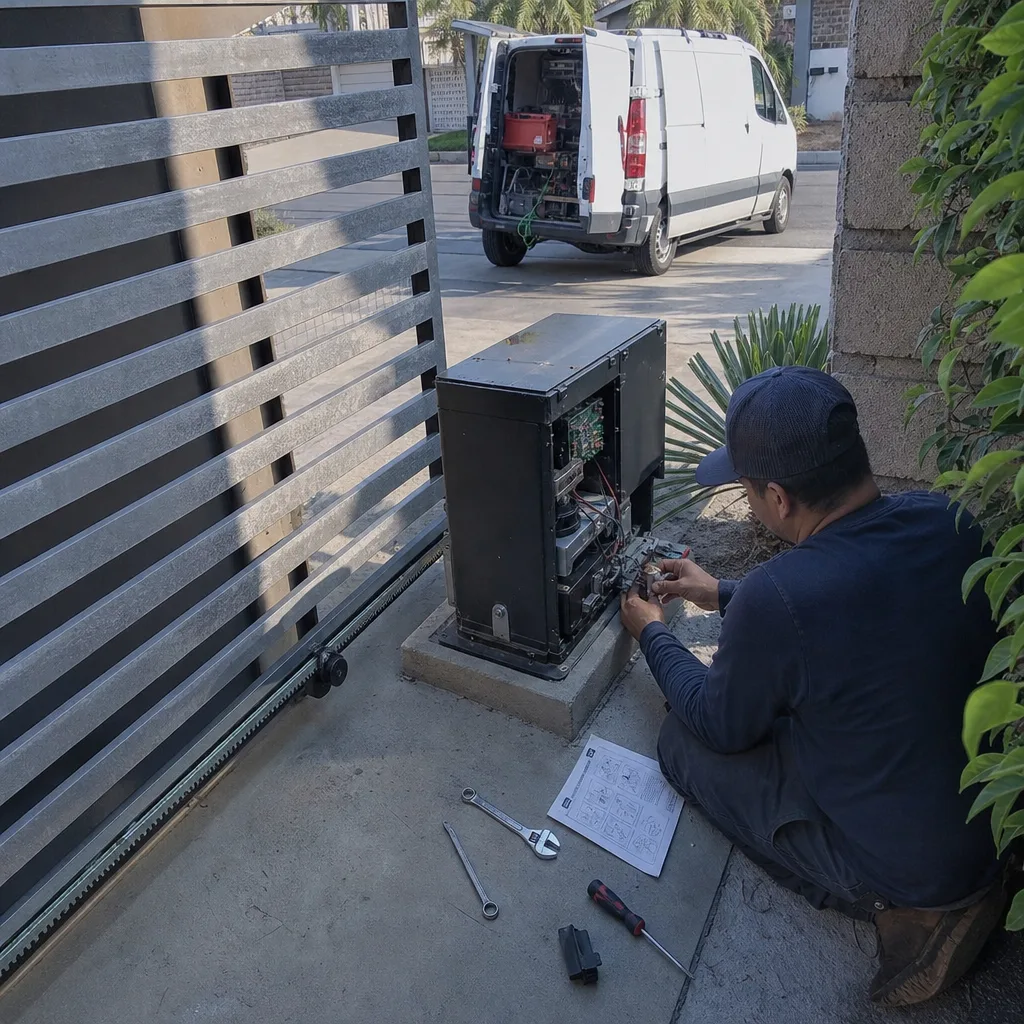
- A grinding or gravelly sound from the motor itself during travel. This usually indicates a gearbox issue. On brands like Linear and Ghost Controls, the gear train is sealed, but a failing gear still changes the motor’s acoustic signature. The fix is usually a motor rebuild or replacement, not a full gate motor and opener replacement.
- A rhythmic clicking that speeds up and slows down with gate travel. This is often a worn chain or a loose chain tensioner on a slide gate, or a hinge pin moving in an elongated hole on a swing gate. The click is mechanical, not electrical, and it will get worse.
- A high-pitched whine that appears only under load, such as on an incline or in high wind. This is the sound of the motor’s windings working near their thermal limit. It is more common in Santa Ana’s hot afternoons and on gates with heavy decorative panels.
- A single loud clunk at the beginning or end of travel. This is typically a limit switch that has drifted out of position, allowing the gate to hit the mechanical stop instead of stopping on the electrical limit. Every clunk is a hammer blow to the motor’s output shaft.
The diagnostic rule we use: a noise that has always been there is usually not an urgent problem. A noise that is new, or that has gotten louder over two or three weeks, is a component telling you it is failing. Record the noise on your phone. Thirty seconds of audio is worth more than any verbal description.
Photo-Eye and Safety Edge Warning Signs Most People Miss
A photo-eye (the infrared beam that stops the gate if something crosses the path) and a safety edge (the pressure-sensitive strip along the gate’s leading edge) are the two components most likely to fail without producing any visible symptom. Until they are tested, they look fine.
The warning signs are behavioral, and they require active observation:
- The gate reverses before reaching the full close position, but only sometimes. This often means the photo-eye beam is partially misaligned. In the right light, the beam aligns and the gate closes. In evening light or after a temperature shift that expands the bracket, the beam misses the receiver and the gate reads it as an obstruction.
- The gate closes, touches the stop, and immediately reverses. This can be a photo-eye mounted in a position where the gate itself crosses the beam at the end of travel, but it is also the classic sign of a dead safety edge circuit. If the edge is shorted or the wireless edge transmitter has failed, the board may see a constant open signal.
- The gate does not stop when you press the close button a second time. On properly configured residential systems, a second press should stop the gate mid-travel. If the gate ignores the command, the wiring to the control inputs or the board itself is compromised.
You can test a photo-eye yourself safely: hold a piece of cardboard across the beam path while the gate is closing. The gate should stop and reverse within one second. Do not use your hand. If the gate does not respond, the safety circuit is not functioning, and that is a call you make before the next visitor or delivery driver walks through.
We service photo-eyes and safety edges on every automation brand we work on, including DoorKing and Viking systems installed years ago in Santa Ana’s older gated properties. A failed safety edge is not a convenience problem. It is an entrapment hazard, and it warrants immediate attention.
Common Mistakes to Avoid
- Lubricating the motor or gearbox. Residential gate motors are sealed units. Spraying lubricant into a sealed gearbox does nothing except void the warranty and often washes existing grease out of the bearings. Lubricate the gate hinges and wheels, never the motor.
- Waiting for complete failure before calling. A gate that still opens but opens slowly, noisily, or intermittently is repairable in most cases. The same gate after a motor burnout or board failure is replaceable, and the cost difference in Santa Ana is typically double to triple.
- Replacing the opener before diagnosing the gate itself. If the gate is heavy, misaligned, or binding, a new opener will fail for the same reason the old one did. The gate is the load. The opener is just the muscle.
- Ignoring a photo-eye that has been disabled or bypassed. Some homeowners or prior technicians disable the safety circuit to stop nuisance reversals. What they are actually doing is disabling the only mechanism preventing the gate from closing on a child, a pet, or a car bumper.
- Assuming a slow gate is just an old gate. Gates do not slow down with age, the way a car might. They slow down because something is resisting movement. The gate’s age is not the diagnosis.
- Adjusting limit switches by guesswork. Setting a limit switch requires understanding the motor’s torque curve and the gate’s travel geometry. Guessing at it can create a stall condition that burns out the board on the next cycle.
When to Call a Professional
Call a professional the moment you observe a measurable change in cycle time of more than 2 seconds, a post lean beyond 1.5 degrees, a weld crack that opens under hand pressure, or any photo-eye or safety edge that fails a cardboard test. These are not wait-and-see situations. They are early-phase failures that become expensive failures quickly.
Vance Gate Repair Santa Ana offers free estimates in Santa Ana, a written price before any work starts, and a documented photo record of everything found and fixed on every visit. Call (657) 286-4793. A live person answers.
Frequently Asked Questions
Gate repair in Santa Ana typically runs between $150 and $450 for most hinge, wheel, limit switch, and alignment corrections. Circuit board replacements usually fall between $300 and $600 depending on the brand and model. Motor replacements for swing and slide gates range from $800 to $1,800 including labor, depending on the brand, gate weight, and whether the mounting hardware can be reused. Every price is written and agreed before any work begins, so the final invoice matches the quote. Call (657) 286-4793 for an exact quote for your gate. Estimates are free.
A gate motor that is dying typically shows three signs: cycle time has increased by more than 2 seconds from your measured baseline, the motor housing is hot to the touch after ten consecutive cycles, and the motor makes a new whining or grinding noise under load. Any one of these is worth a diagnostic call. All three together usually mean the motor is in the final weeks of its service life.
For emergency situations, including a gate stuck open, a gate stuck closed with a car trapped inside, or a safety edge failure, same-day service in Santa Ana is available and a live person answers the phone 24 hours a day. Call (657) 286-4793 and we will dispatch a technician. For non-emergency inspections, we schedule at the earliest available slot and always confirm the exact time.
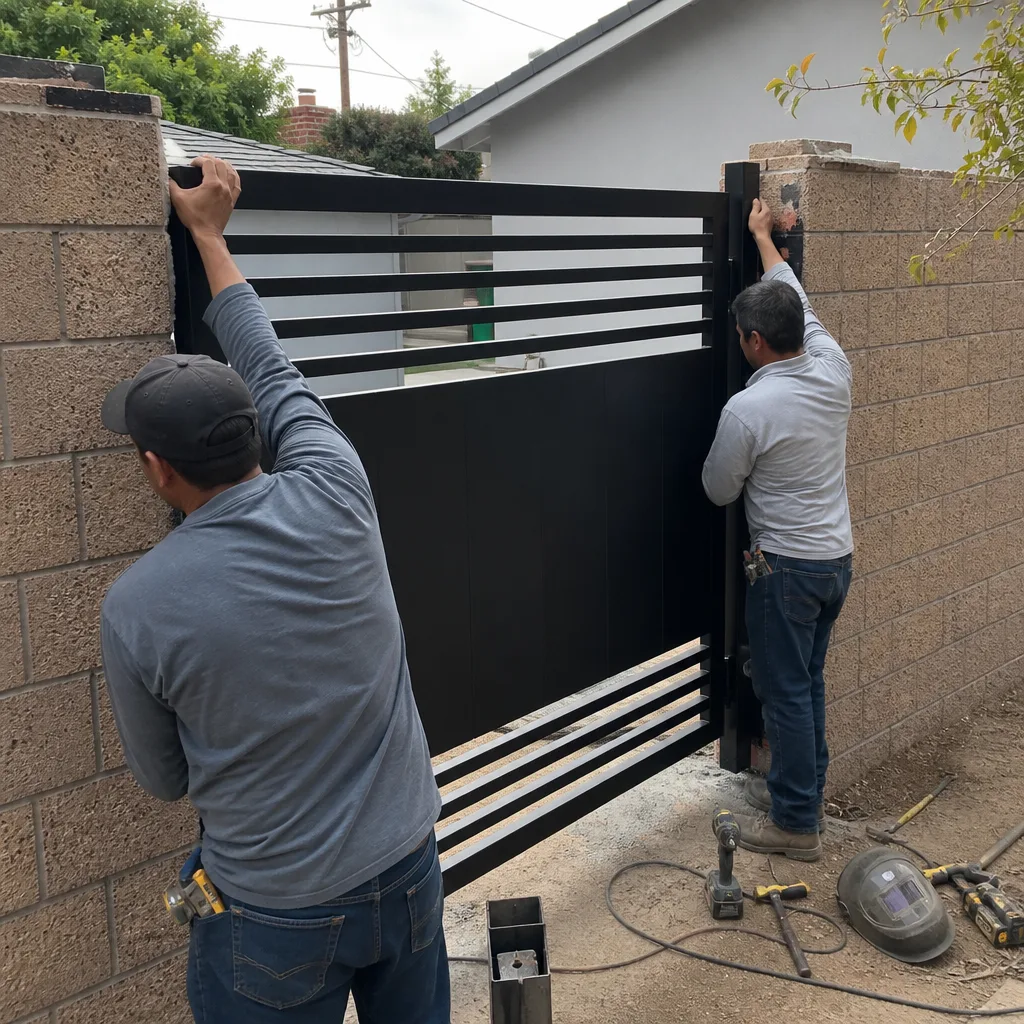
A complete gate replacement involves removing the old gate and posts, excavating the old footings, pouring new footings sized for the gate’s weight and the soil conditions, fabricating or installing the new gate, hanging and aligning it, and installing or reinstalling the automation system, including the safety photo-eyes and edges. In Santa Ana’s clay soil, we typically over-size the footings by 20 percent compared to standard practice to resist ground heave. The full scope and price are written before any work begins.
Yes. Every gate automation system we install includes the full low-voltage power run from the nearest source to the motor, all conduit and junction boxes, the photo-eye pair, and the safety edge on the leading edge of the gate. These are not optional add-ons. They are part of the installation, and they are itemized on the written estimate you receive before the work starts.
Intermittent gate operation in Santa Ana usually traces back to one of four causes: a photo-eye that is marginally misaligned and reads as blocked only under certain conditions, a corroded ground connection that changes resistance with temperature, a failing power supply in the access control system, or a limit switch that has drifted and only makes contact intermittently. The specific cause can be identified on a diagnostic visit, and the fix is usually straightforward once it is found.
The Bottom Line
A gate failure in Santa Ana rarely happens without warning. The warning is there: a measurable slowdown, a new noise, a hairline crack at the hinge, a post drifting out of plumb. The difference between a $200 hinge repair and a $1,800 motor replacement is usually not money. It is attention. Time your gate, level your post, photograph what you see, and call when the measurement leaves the normal range. That is what the measurement is for.
For more detail on what a diagnostic visit covers and what repairs cost in Santa Ana, see our guide to Gate Repair in Santa Ana. If your gate has reached the point where repair is no longer economical, our Gate Installation in Santa Ana page outlines the replacement process from footing to final test. And if the motor is the specific component in question, the Gate Motor & Opener in Santa Ana page covers diagnosis, repair, and replacement in detail. Everything starts with a Vance Gate Repair Santa Ana home visit, a written estimate, and a conversation with a live person at (657) 286-4793.
Written by Adrian Vance, Owner at Vance Gate Repair Santa Ana, serving Santa Ana since 2014.